
Featured • Multi-Ordinance Academic Engine
Anviksha
Multi-Ordinance Academic Engine — a project by Himanshu Singh Dangi, Frontend & Full Stack Developer.
About this project








Overview
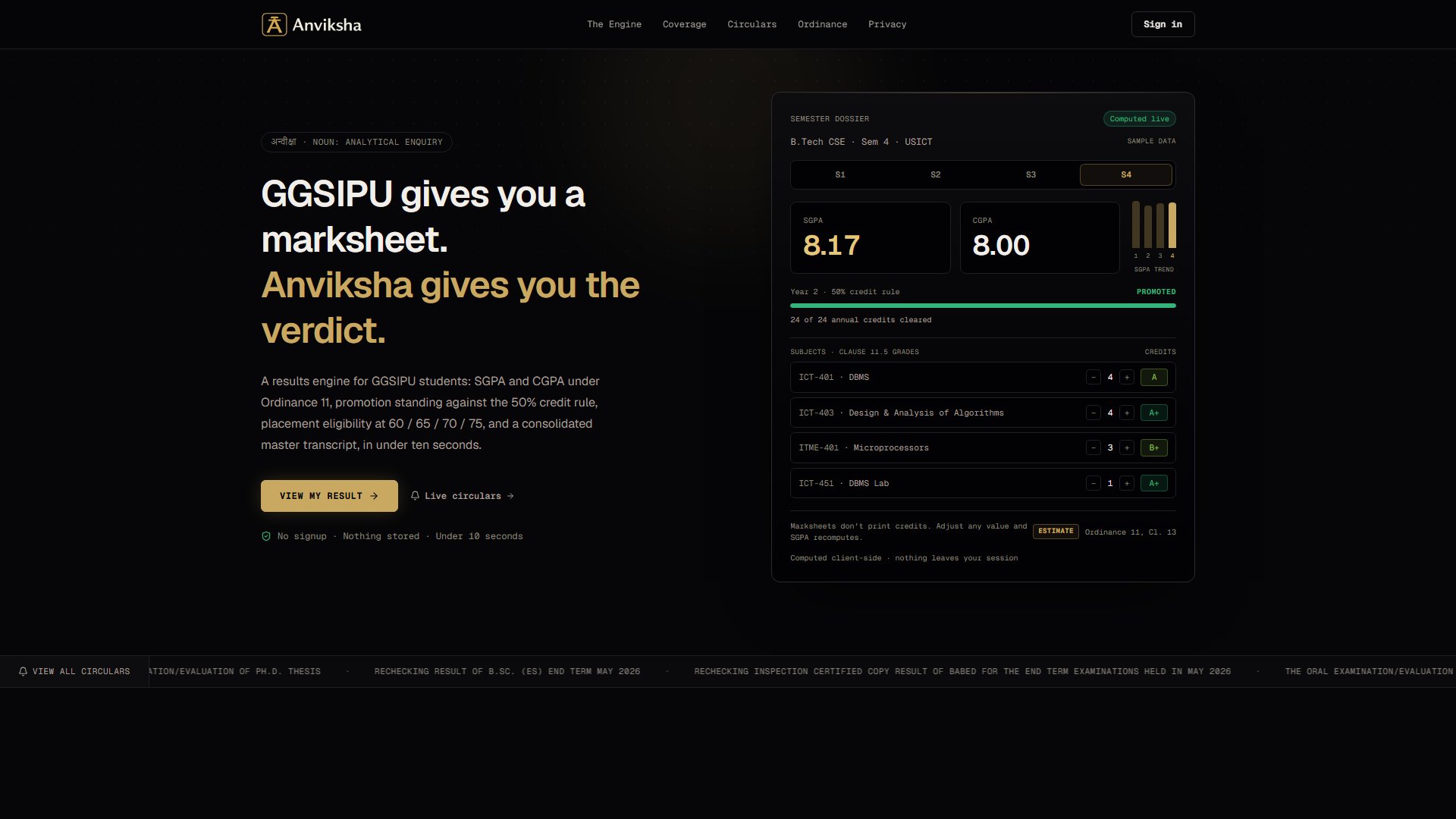
Anviksha (अन्वीक्षा — "analytical enquiry") is a student-built academic results and analytics platform for Guru Gobind Singh Indraprastha University (GGSIPU). It interfaces with the university examination portal (examweb.ggsipu.ac.in) as a stateless, privacy-first proxy layer — no database, no stored credentials, no retained records.
Rather than showing only a raw table of marks, Anviksha interprets result data through an ordinance-based academic engine (src/lib/academic/) built on official GGSIPU ordinances — Ordinance 11 for semester degrees, plus separate verified frameworks for MBBS (Ord. 15), MD/MS (Ord. 16), BHMS (Ord. 22), BASLP (Ord. 24), BPT/BOT (Ord. 31), and BAMS (Ord. 38):
- Real-time SGPA and CGPA computation with interactive credit adjustments.
- Annual promotion standing based on the verified 50%-credits baseline (Ordinance 11, Clause 11.3(v)).
- Placement eligibility benchmarks against common campus recruitment cutoffs (60%, 65%, 70%, 75%).
- Odd/Even reappearance session planning for backlog papers.
- Client-side consolidated academic transcripts and marksheets (clearly marked unofficial).
- Live official GGSIPU examination circulars, date-sheets, and notices refreshed every 15 minutes.
- Honest result viewing for every programme — analytics appear only where rules are verified; everything else is shown as raw marks with an explanation instead of a guessed number.
Disclaimer: Anviksha is an independent, unofficial student application and is not affiliated with or endorsed by GGSIPU. Official university marksheets always supersede any calculation shown here.
Table of Contents
- Core Design Principles
- Key Features
- The Ordinance-Based Engine
- Programme Coverage
- Technology Stack
- Getting Started
- Project Structure
- Architecture & Data Flow
- Grading Reference (Ordinance 11)
- Scripts
- Testing & Verification
- Security & Privacy
- Deployment
- Documentation
- Author
Core Design Principles
- Zero-Storage Privacy — Credentials, marks, and personal data are proxied, never persisted. There is no database anywhere in the stack.
- Honesty Over Guesswork — Every calculated metric carries a verification state:
VERIFIED(statutory rule confirmed),RESULT_DERIVED(computed directly from official marks),WARNING(depends on estimated/user credits),NOT_APPLICABLE(the programme's ordinance doesn't define it),UNAVAILABLE(withheld rather than guessed), orAMBIGUOUS(programme framework unclear). - Fail-Closed Rendering — If a programme's rules aren't verified, analytics aren't shown — Ordinance-11-shaped math is never silently applied to a medical or allied-health programme where it doesn't belong.
- Tested Evolution — The engine (
src/lib/academic/) is type-checked and unit-tested (108 automated tests) and grows as ordinance verification progresses.
Key Features
1. Privacy-First Session Proxy
- Direct Server Proxy: Credentials and results are relayed through Next.js Route Handlers straight to the official university endpoints (
/web/login,/web/Logout,/web/student/search,/web/captcha). - SHA-256 Password Hashing: The password is hashed with the captcha salt (
sha256(password + captcha)) before leaving — mirroring the portal's own behaviour, so no plaintext password travels. - Ephemeral Sessions: The upstream
JSESSIONIDis captured server-side and stored inHttpOnlycookies scoped to/api, expiring after one hour or on logout. - Middleware Guard (
src/proxy.ts): Protects/dashboardand/api/result, redirecting expired sessions to/login?expired=trueand preventing logged-in users from re-entering the login page. - Full-Fetch Strategy (
euno=100): All semester results are fetched in a single upstream call at login.
2. Ordinance-Based Academic Engine (src/lib/academic/)
- Exact Ordinance 11 Arithmetic: SGPA = Σ(Cᵢ × Gᵢ) / ΣCᵢ and CGPA across all semesters — both rounded to two decimals, exactly as Clause 13 specifies; equivalent percentage = CGPA × 10.
- Live Credit Overrides: Official marksheets don't print credits. Anviksha estimates them (theory 3, lab/practical 1, project/viva 2), clearly labels every estimate-dependent number with a
WARNINGbadge, and lets you enter exact credits from your scheme — recalculating instantly. - GPA Exclusion Rules: Failed courses (F = 0) still count in the credit denominator; non-numeric legends (CS — Credit Secured, AP — Already Passed) carry no grade point and are excluded rather than zeroed.
- Promotion Monitor (Clause 11.3(v)): Tracks earned vs. required credits per academic year against the verified 50% baseline. Extra conditions that belong to statutory bodies or programme schemes are noted as "may apply" — never invented.
- Placement Benchmarks: Compares CGPA against 60/65/70/75% cutoff tiers commonly used in campus recruitment — explicitly presented as application benchmarks, not university rules.
- Odd/Even Backlog Planner: Segregates reappear papers into upcoming examination windows (Nov/Dec vs May/June) based on their semester.
- Division Classification (Clause 13): Exemplary Performance (CGPA 10.00 with every course passed on the first chance — condition disclosed) / First / Second / Third Division.
3. Honest Result Viewing
- One viewer renders every programme's result: verified programmes get full analytics; others show published marks with reason chips instead of invented GPAs.
- Normalizes raw statuses (ABS/CAN/DET/RL/CS/AP) into precise result states — an unknown code is never auto-converted into a pass or fail.
4. Live Examination Notices Feed (/notices)
- 15-Minute ISR Sync: Server-side fetch of
ipu.ac.in/exam_notices.php(Cheerio) with 900-second Incremental Static Regeneration. - Auto-Categorization: Flags circulars into Results Declared, Date-Sheets, Inspection Schedules, and General Notices.
- Instant Search: Client-side keyword filtering across titles and dates with direct PDF links.
5. Client-Side Document Export
- Consolidated Academic Transcript: Print-ready single-page record with full semester history and credit summaries — clearly marked "UNOFFICIAL — for verification & recruitment reference".
- Semester Marksheets: Detailed individual marksheets for print/PDF.
- Zero-Server Rendering: Generated entirely in the browser with
html2canvas-pro+jspdf— exports never touch a server.
6. Real-Time Global System Status Indicator
- Live Health Monitoring (
/api/health): Browser measures roundtrip latency to the internal proxy endpoint; automatically classifies states intoOperational(healthy),Slow(> 1000ms), andOffline(server error, timeout after 8s, or network failure). - Subtle, Non-Intrusive Alerting: Stays retracted and hidden during healthy operation; smoothly slides down into view on distinct problem transitions (
Slow,Offline) or upon recovery (Back Online), remaining visible for 12 seconds before retracting. - Navbar Offset Coordination: Employs CSS custom property
--status-strip-offsetand layout spacing so sticky headers smoothly shift without obscuring page content or navigation. - Power & Visibility Conscious: Halts polling intervals and aborts in-flight requests when the browser tab is hidden; resumes checks upon visibility restoration, with immediate offline/online event interception.
7. Landing & SEO Layer
- Animated landing page (Framer Motion) with ordinance-mapping table, grade-scale card, FAQ, and a dashboard hero mockup.
sitemap.ts,robots.ts,manifest.ts, JSON-LD structured data (WebApplication + FAQPage), OpenGraph/Twitter cards, and a transparent methodology guide at/calculations.
The Ordinance-Based Engine
The heart of Anviksha is src/lib/academic/ — a typed, data-driven layer that answers one question per programme: "What are we allowed to claim about this result?"
Raw ExamWeb JSON
      │
      ▼
academic-engine/  →  analyzeResult(raw, userCredits, options)
      │                  • matches programme family + ordinance from academic-db.ts
      │                  • normalizes marks, statuses, and credits
      │                  • merges repeated marksheet rows (cleared reappears win)
      │                  • computes only what the ordinance's capabilities allow
      ▼
EngineResult        →  every metric is a Metric<T>:
      │                  { value, status, reason, sources }
      │                  status ∈ VERIFIED | RESULT_DERIVED | WARNING
      │                         | UNAVAILABLE | AMBIGUOUS | NOT_APPLICABLE
      ▼
Dashboard & Analytics  →  render strictly within capabilities;
                           surface every status and citation
- Ordinance Database (
academic-db.ts): One registry entry per ordinance — ORD_10, ORD_11, ORD_15, ORD_16, ORD_22, ORD_24, ORD_25, ORD_31, ORD_38 — each with its examination system, capability flags, rule bands, and clause-level sources. Programme families (B.Tech, BCA, MBA, Law, MBBS, BPT…) map to their ordinance via keyword matching, with unrecognized names leftAMBIGUOUSrather than defaulted. - Clause Citations: Rules cite the specific clause they implement (e.g. Ordinance 11 Clause 11.5 for the grade table, Clause 13 for SGPA/CGPA/percentage/division, Clause 11.3(v) for the 50% promotion baseline) — verified directly against the printed ordinance text.
- Warnings as UI: Estimates, ambiguities, and unverified rules are structured objects rendered as badges and explanation panels — transparency is a first-class output, not a log line.
- Reappear Merge (
mergeRepeatedSubjectsinsubject-results.ts): ExamWeb prints a repeated subject once per attempt, so a cleared backlog sits next to its own old back row. Rows grouped by paper code + subject name are collapsed to one: a passed attempt beats a failed one, then higher marks, then the first printed row. The dashboard counts one backlog per still-failed paper, shows the winning attempt in SGPA/CGPA, and lists the earlier attempts as history sub-rows with a green Backlog cleared badge.
Programme Coverage
The engine recognizes GGSIPU programme families from the official programme name/code returned by ExamWeb:
| Stream | Programmes | Ordinance |
|---|---|---|
| Semester degrees | B.Tech, M.Tech, BCA, MCA, BBA, MBA, B.Com, BA, BA/BBA LLB | Ordinance 11 — full analytics |
| Medicine | MBBS | Ordinance 15 — marks, pass/fail (50% theory + practical); no divisions by rule |
| Medicine (PG) | MD / MS | Ordinance 16 — pass/fail |
| Homoeopathy | BHMS | Ordinance 22 — percentage, subject distinction |
| Speech & Hearing | BASLP | Ordinance 24 — percentage divisions |
| Weekend programmes | Weekend semester degrees | Ordinance 25 |
| Physiotherapy | BPT / BOT | Ordinance 31 — CPI divisions, all-subjects promotion |
| Ayurveda | BAMS | Ordinance 38 |
Results render for any programme declared on ExamWeb — every affiliated institute (USICT, MAIT, MSIT, BVCOE, BPIT, GTBIT, VIPS, ADGITM, JIMS, DTC, GNDIT, and the rest across Delhi NCR). Unrecognized programme names get honest raw-marks rendering with AMBIGUOUS statutory metrics, never a default formula.
Technology Stack
| Category | Technology | Purpose |
|---|---|---|
| Framework | Next.js 16.2 (App Router, Turbopack) | Server Components, ISR caching, Route Handlers, middleware |
| Library | React 19.2 (+ React Compiler) | Client UI, concurrent rendering |
| Language | TypeScript 5.9 | End-to-end type safety |
| Styling | Tailwind CSS v4 (@tailwindcss/postcss) |
Obsidian-dark design tokens, responsive layout |
| Motion | Framer Motion v12 | Fluid transitions, hero micro-interactions |
| State | Zustand v5 | In-memory result caching & credit overrides |
| Parsing | Cheerio v1 | Notices scraping & normalization |
| Charts | Recharts v3 | SGPA trends, grade distributions, internal/external splits |
| Forms | react-hook-form + Zod | Validated login & report forms |
| PDF Export | html2canvas-pro + jspdf | Client-side transcript/marksheet generation |
| Testing | Vitest v4 + Testing Library + jsdom | Unit, engine & route tests |
| Analytics | Vercel Analytics | Performance vitals & telemetry |
Getting Started
Prerequisites
- Node.js 20+ and npm
Setup
# Clone the repository
git clone <your-repo-url>
cd anviksha

# Install dependencies
npm install

# Start the development server (Turbopack)
npm run dev
Open http://localhost:3000. Sign in with your GGSIPU enrollment number, password, and the captcha shown (relayed live from the university portal).
No environment variables are required — the app is deliberately configuration-free and stateless.
Project Structure
anviksha/
├── public/                         # Static assets (icons, logos)
├── src/
│   ├── proxy.ts                    # Middleware: auth guards for /dashboard, /api/result, /login
│   │
│   ├── lib/academic/               # ▸ Ordinance-based academic engine (pure TypeScript)
│   │   ├── academic-db.ts          #   Ordinance registry: capabilities, rule bands, clause sources
│   │   ├── academic-engine/        #   analyzeResult(): normalization + verified computation
│   │   │   ├── index.ts            #     orchestrator — composes every derived metric
│   │   │   ├── subject-results.ts  #     row parsing, credits, status, grades, reappear merge
│   │   │   └── rules/              #     promotion, reappear, division, placement
│   │   └── academic-engine.test.ts #   Engine unit tests
│   │
│   ├── app/                        # Next.js App Router
│   │   ├── layout.tsx              #   Root layout: fonts, SEO metadata, JSON-LD
│   │   ├── page.tsx                #   Landing page
│   │   ├── manifest.ts / robots.ts / sitemap.ts
│   │   ├── (auth)/login/           #   Login page with captcha proxy
│   │   ├── (app)/
│   │   │   ├── dashboard/          #   Result overview + /dashboard/analytics deep dossier
│   │   │   ├── notices/            #   Live exam circulars (15-min ISR)
│   │   │   ├── calculations/       #   Transparent ordinance methodology guide
│   │   │   └── report/             #   User feedback & diagnostics
│   │   └── api/(auth)/
│   │       ├── captcha/route.ts    #   Captcha image relay + JSESSIONID capture
│   │       ├── health/route.ts     #   Stateless heartbeat & server responsiveness ping
│   │       ├── login/route.ts      #   Credential proxy → upstream /web/login
│   │       ├── logout/route.ts     #   Session destruction + upstream /web/logout
│   │       └── result/route.ts     #   Full result fetch (euno=100) + normalization
│   │
│   ├── components/
│   │   ├── home/                   #   Hero, engine bento, coverage, trust, FAQ/CTA sections
│   │   ├── login/                  #   LoginForm
│   │   ├── dashboard/              #   CreditTipModal, skeletons, avatar, logout
│   │   ├── analytics/              #   Promotion, Placement, Division, Trends, Reappear,
│   │   │                           #   ExplanationPanel, QuickStats cards
│   │   ├── export/                 #   ConsolidatedMasterTranscript, ResultGradeSheet
│   │   ├── notices/                #   NoticesClientView (search + categories)
│   │   └── common/                 #   AppNavbar, SystemStatusStrip, ErrorBoundary, FloatingReport
│   │
│   ├── helpers/
│   │   └── notices.ts              #   IPU notices fetcher & category classifier
│   │
│   ├── store/result-store.ts       #   Zustand: active result + custom credit overrides
│   ├── types/                      #   StudentProfile, Result, Notice, ApiResponse types
│   └── validations/                #   Zod schemas (login credentials)
│
├── vercel.json                     # Vercel config (BOM region, 30s function ceiling)
└── vitest.config.mjs               # Test configuration (jsdom, coverage)
Architecture & Data Flow
 Browser                                    Anviksha (Next.js)                GGSIPU Portal
─────────────                          ──────────────────────────         ───────────────────
 Enter credentials + captcha
        │                                        │
        ▼                                        ▼
 Zod validation ─────────────────►  POST /api/(auth)/login ─────────►  POST /web/login
 sha256(password + captcha salt)          │  (captures JSESSIONID           │
        │                                 │   into HttpOnly cookie)         ▼
        │                                 │                          session established
        ▼                                 ▼
 Dashboard request ──────────────►  GET /api/(auth)/result ─────────►  student/search
        │                                 │  (euno=100 full fetch)         ?euno=100
        │                                 ▼
        │                          academic-engine/
        │                          (analyzeResult + academic-db)
        ▼                                 ▼
 Zustand store (in-memory) ◄────── EngineResult with per-metric verification
        │
        ├──► Dashboard, Analytics (verification-badged rendering)
        └──► PDF Transcript export (client-side only)

 Logout ─────────────────────────►  POST /api/(auth)/logout ────────►  GET /web/logout
                                        (cookies destroyed)
Session lifecycle: middleware (src/proxy.ts) checks the auth_session cookie on every protected request; expired sessions receive a 401 SESSION_EXPIRED (API) or a redirect to /login?expired=true (pages).
Grading Reference (Ordinance 11)
| Marks Range | Letter Grade | Grade Points |
|---|---|---|
| 90 – 100 | O (Outstanding) | 10 |
| 75 – 89 | A+ (Excellent) | 9 |
| 65 – 74 | A (Very Good) | 8 |
| 55 – 64 | B+ (Good) | 7 |
| 50 – 54 | B (Above Average) | 6 |
| 45 – 49 | C (Average) | 5 |
| 40 – 44 | P (Pass) | 4 |
| < 40 or absent | F (Fail) | 0 |
- Passing rule: Total (continuous evaluation + term end) ≥ 40%, uniform per programme — Clause 11.1; Grade P is the baseline passing grade — Clause 11.5.
- SGPA = Σ(Cᵢ × Gᵢ) / ΣCᵢ · CGPA = cumulative across all semesters · Equivalent % = CGPA × 10 — all Clause 13.
- Division (Clause 13): Exemplary (CGPA 10.00, every course first-chance, no academic break) · First ≥ 6.50 · Second 5.00–6.49 · Third 4.00–4.99.
- Promotion (Clause 11.3(v)): ≥ 50% of the existing year's total credits; failure triggers an academic break (max two per programme).
- Special statuses (
ABS,CAN,DET,RL,CS,AP) map to precise result states, never guessed as pass/fail.
Scripts
| Command | Description |
|---|---|
npm run dev |
Start the dev server (Turbopack) |
npm run build |
Production build |
npm start |
Serve the production build |
npm run lint |
ESLint across the project |
npm test |
Run the full Vitest suite |
npm run test:watch |
Vitest in watch mode |
npm run test:coverage |
Test run with coverage report |
npx tsc --noEmit |
TypeScript type-check |
Testing & Verification
The project maintains a 108-test automated suite (7 files) covering the academic engine, notices scraper, system status strip, validators, and API routes:
npm test              # 108 tests, currently 100% green
npx tsc --noEmit      # clean
npm run lint          # 0 errors
npm run build         # production bundle
| Suite | Focus |
|---|---|
lib/academic/academic-engine.test.ts |
Ordinance rules, grades, SGPA/CGPA, CS/AP exclusion, promotion, reappear merge |
components/dashboard/dashboard-metrics.test.ts |
Dashboard tabs, backlog counting after a cleared reappear |
components/common/SystemStatusStrip.test.tsx |
Heartbeat latency, Slow/Offline classification, 12s timer, tab visibility, network events |
helpers/notices.test.ts |
Notices fetching & categorization |
validations/login.validation.test.ts |
Credential schema validation |
app/api/(auth)/login|result route tests |
Proxy route behaviour & error paths |
Security & Privacy
- Zero database. Nothing is persisted server-side — no credentials, marks, or logs of academic records.
- HttpOnly, path-scoped (
/api), expiry-bound cookies hold the upstream session token; the browser never exposes it to scripts. - Password hashing (
sha256(password + captcha salt)) mirrors the portal's own behaviour — plaintext passwords never travel. - Middleware access control on all protected routes with explicit session-expiry signalling.
- Found a vulnerability? Open a private-security advisory on the GitHub repository and it will be acted on immediately.
Deployment
Deployed on Vercel (vercel.json):
- Region:
bom1(Mumbai) for lowest latency to GGSIPU infrastructure. - API route
maxDuration: 30s to comfortably cover upstream portal latency. - Framework: Next.js auto-detected; analytics via
@vercel/analytics.
Any Next.js-compatible host works — the app has no server-side state or environment dependencies.
Documentation
| Document | Contents |
|---|---|
/calculations |
In-app methodology guide: every formula, badge, and its ordinance clause |
Author
Designed and built by Himanshu Singh.
Disclaimer: Anviksha is an independent, student-built analytics layer and is not affiliated with or endorsed by GGSIPU. All academic decisions remain subject to official university records and ordinances.
- 01 Anvaya Lab Full Stack API Client →
- 02 DevToolkit AI AI Developer Toolkit →
- 03 Vidyavriksha Full Stack Platform →
- 04 Inside Campus Team Lead • Hackathon →
- 05 Sutra Ecom MERN E-Commerce →
- 06 TVGF Website Client Project →
- 07 Portfolio Website Personal Portfolio →
- 08 Weather App API Integration →
- 09 PostFinder JavaScript Project →