
Featured • AI Developer Toolkit
DevToolkit AI
AI Developer Toolkit — a project by Himanshu Singh Dangi, Frontend & Full Stack Developer.
About this project
High-Performance AI Orchestration & Developer Productivity Suite
Overview
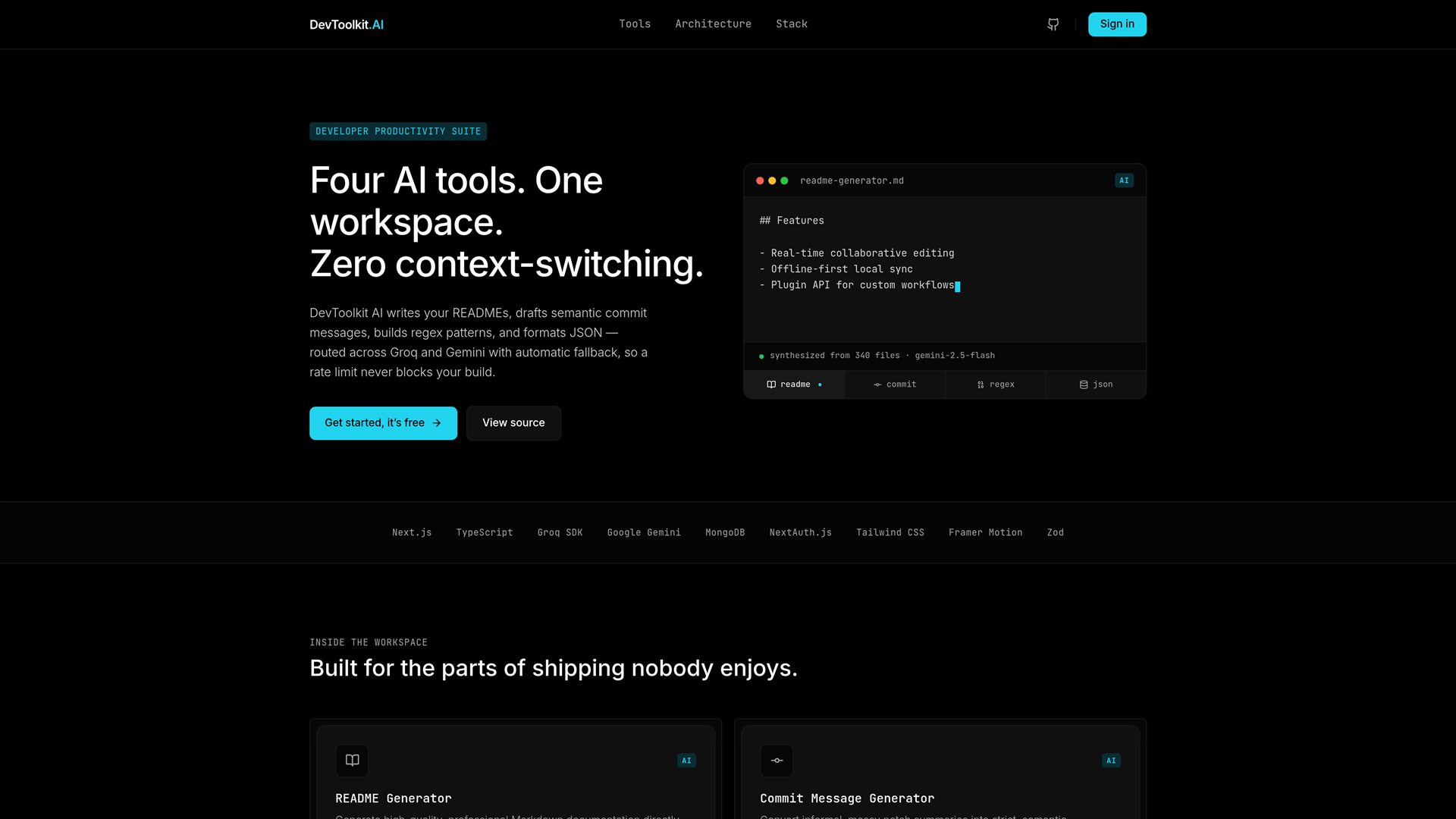
DevToolkit AI is a sophisticated developer productivity platform engineered to bridge the gap between raw LLM capabilities and practical software engineering workflows. By leveraging a dual-engine inference architecture, the platform provides developers with a specialized toolkit for deep documentation synthesis and high-speed code analysis. The system is designed to handle complex technical tasks—such as generating comprehensive READMEs, analyzing git diffs, and auditing folder structures—while maintaining extreme efficiency in token consumption and latency.
The core value proposition lies in its intelligent orchestration layer. Unlike standard AI wrappers, DevToolkit AI implements a split-topology inference strategy. It distinguishes between tasks requiring deep reasoning and those requiring rapid execution, routing them to the optimal engine (Google Gemini or Groq) based on complexity and input size. This ensures that developers receive high-fidelity technical documentation without the overhead of unnecessary latency or excessive API costs.
The platform integrates deeply with the developer's local context. Through advanced client-side preprocessing, the system intelligently strips redundant data from git diffs, such as dependency lockfiles, ensuring that the LLM context window is reserved for meaningful code changes. This architectural decision significantly improves the accuracy of the generated outputs and reduces the likelihood of hallucinated file references by implementing a structural auditing guardrail that cross-references AI output against the actual project filesystem.
Security and reliability are foundational to the architecture. With built-in rate limit enforcement via a custom UsageModel, round-robin API key pooling to maximize throughput, and strict Zod-based schema validation for all API interactions, DevToolkit AI provides a robust, production-ready environment for AI-assisted development.
Technology Stack
| Layer | Technology | Version/Implementation |
|---|---|---|
| Framework | Next.js | 16.2.10 (App Router, Server Components) |
| Language | TypeScript | 5.9.3 |
| Database | MongoDB | via Mongoose 9.7.4 |
| Authentication | NextAuth.js | 5.0.0-beta.31 |
| Inference (Deep) | Google Gemini | Deep Synthesis Pipeline |
| Inference (Fast) | Groq SDK | High-Speed Inference Engine |
| Validation | Zod | 4.4.3 (Runtime Schema Validation) |
| Styling | Tailwind CSS | 4 |
| UI Components | Framer Motion | Animation & Transitions |
| Icons | Lucide React | Vector Iconography |
| Syntax Highlighting | Shiki | Professional Code Rendering |
| JSON Visualization | @uiw/react-json-view | Structured Data Inspection |
Key Features
Split-Topology Inference Orchestration The system utilizes a sophisticated routing mechanism that separates tasks into two distinct pipelines. Deep Synthesis tasks, which require high-level reasoning and complex markdown generation, are routed to Google Gemini. Fast Inference tasks, such as quick code explanations or small-scale transformations, are routed to the Groq engine. This ensures optimal resource allocation and cost-efficiency.
Round-Robin API Key Pooling To circumvent standard API rate limits and maximize continuous throughput, the platform implements a custom pooling strategy. By managing a rotating list of Gemini API keys within the service layer, the system can distribute requests across multiple credentials, ensuring high availability even during periods of intense developer activity.
Dynamic Model Fallback & Routing The Groq-based inference engine features an intelligent fallback chain. The system evaluates the character count and complexity of the input to select the most appropriate model:
llama-3.1-8b-instantfor lightweight, high-speed tasks, orgroq/compound-minifor larger, more complex payloads. In the event of a 429 (Too Many Requests) error, the system automatically triggers a failover mechanism to maintain service continuity.Intelligent Context Preprocessing To optimize token usage and reduce latency, the platform includes a specialized preprocessing layer. The
CommitGenerator.tsxcomponent utilizes apreprocessDiffutility that identifies and strips heavy, non-functional files likepackage-lock.jsonandyarn.lockfrom git diffs before they are sent to the inference engines.Structural Auditing & Hallucination Prevention The Gemini synthesis pipeline includes a dedicated verification guardrail. This layer cross-references the AI-generated documentation against the actual project folder layout. By validating that every file path and directory mentioned in the documentation actually exists in the workspace, the system effectively eliminates the common issue of AI-generated path hallucinations.
Granular Usage & Quota Management The platform implements a strict rate-limiting and quota enforcement system. Using a dedicated
UsageModel, the application tracks daily request quotas per user, ensuring fair resource distribution and preventing API exhaustion through real-time monitoring and enforcement at the API layer.
Directory & Code Architecture Layout
src/
├── app/
│   ├── (app)/
│   │   ├── (auth)/
│   │   │   └── login/
│   │   │       └── page.tsx             # OAuth authentication entry point
│   │   ├── workspace/
│   │   │   └── page.tsx                 # Primary application hub/dashboard
│   │   └── layout.tsx                   # Global context and navigation shell
│   ├── api/
│   │   ├── gemini/                      # Deep synthesis orchestration endpoints
│   │   ├── grok/                        # Fast inference routing endpoints
│   │   ├── history/                     # User activity CRUD endpoints
│   │   └── usage/                       # Rate limit enforcement endpoints
├── context/
│   └── AppContext.tsx                   # Centralized state (tools, session, quotas)
├── lib/
│   ├── geminiService.ts                 # Two-layer synthesis pipeline logic
│   ├── groqService.ts                   # Model routing and fallback management
│   ├── rateLimiter.ts                   # Quota enforcement logic
│   ├── constants.ts                     # API key pooling and configuration
│   └── [other-services].ts
├── models/
│   ├── history.model.ts                 # Task log persistence schema
│   ├── usage.model.ts                   # Daily request quota schema
│   └── user.model.ts                    # User profile persistence schema
├── validations/
│   ├── groq.validation.ts               # Zod schema for Groq API inputs
│   ├── history.validation.ts            # Zod schema for history operations
│   └── readme.validation.ts             # Zod schema for documentation requests
└── components/
    └── CommitGenerator.tsx              # Diff preprocessing and generation UI
File Responsibility Mapping
| File/Directory | Responsibility |
|---|---|
src/app/api/gemini/ |
Handles complex, multi-layer documentation synthesis requests. |
src/app/api/grok/ |
Manages high-speed, low-latency inference routing. |
src/lib/geminiService.ts |
Implements Layer 1 (Analysis) and Layer 2 (Synthesis) pipelines. |
src/lib/groqService.ts |
Executes dynamic model selection and automatic 429 failover. |
src/lib/constants.ts |
Manages the CSV-based round-robin API key rotation logic. |
src/lib/rateLimiter.ts |
Intercepts requests to enforce limits defined in UsageModel. |
src/validations/ |
Ensures strict runtime type integrity for all incoming API payloads. |
src/context/AppContext.tsx |
Provides real-time state for tool selection and quota tracking. |
Usage Guidelines & Code Examples
Inference Orchestration Logic
The following logic demonstrates how the system selects models based on input complexity within the groqService.ts implementation.
// Conceptual implementation of the dynamic model fallback chain
async function routeInferenceRequest(input: string) {
  const inputSize = input.length;
  let selectedModel: string;

  // Dynamic model selection based on input character count
  if (inputSize < 2000) {
    selectedModel = 'llama-3.1-8b-instant';
  } else {
    selectedModel = 'groq/compound-mini';
  }

  try {
    return await executeGroqInference(selectedModel, input);
  } catch (error) {
    if (error.status === 429) {
      // Automatic failover on rate limit error
      return await executeGroqInference('fallback-model', input);
    }
    throw error;
  }
}
API Key Pooling Strategy
The constants.ts file manages the rotation of Gemini keys to maximize throughput.
// Round-robin key rotation logic
const GEMINI_KEYS = ["key_1", "key_2", "key_3", "key_4"];
let currentKeyIndex = 0;

export const getNextGeminiKey = (): string => {
  const key = GEMINI_KEYS[currentKeyIndex];
  currentKeyIndex = (currentKeyIndex + 1) % GEMINI_KEYS.length;
  return key;
};
Configuration & Environment Variables
The following environment variables are required for the application to function correctly. Ensure all keys are stored securely and never committed to version control.
| Variable | Description | Scope |
|---|---|---|
MONGODB_URI |
Connection string for the MongoDB instance | Server |
NEXTAUTH_SECRET |
Secret used for encrypting NextAuth sessions | Server |
GEMINI_API_KEYS |
Comma-separated list of Gemini API keys for pooling | Server |
GROQ_API_KEY |
Primary API key for the Groq inference engine | Server |
GOOGLE_CLIENT_ID |
OAuth client ID for Google authentication | Client/Server |
GOOGLE_CLIENT_SECRET |
OAuth client secret for Google authentication | Server |
Unique Aspects & Custom Focuses
Split-Topology Inference Pipeline
The most significant architectural distinction in DevToolkit AI is the separation of concerns between the Gemini and Groq engines.
Deep Synthesis (Gemini): This is not a single-pass request. The
geminiService.tsimplements a two-layer pipeline. Layer 1 performs a structural analysis and verification of the provided context. Layer 2 performs the actual Markdown synthesis. This ensures that the final output is not just grammatically correct, but structurally sound and contextually accurate.Fast Inference (Groq): This pipeline is optimized for speed. By using a dynamic model fallback chain, the system ensures that small tasks do not consume the high-capacity resources required for larger tasks, while still providing a safety net via automatic failover if the primary high-speed model hits a rate limit.
Advanced Context Optimization
To solve the problem of "token bloat" in developer tools, the CommitGenerator.tsx component implements a specialized preprocessDiff method. In a standard git diff, dependency lockfiles (like package-lock.json) can account for 90% of the file size without providing any semantic value to an AI. By stripping these files before the data reaches the service layer, DevToolkit AI:
- Reduces API latency.
- Lowers token costs significantly.
- Prevents the LLM from getting "lost" in thousands of lines of non-code data.
Structural Auditing Guardrail
To combat the inherent tendency of LLMs to hallucinate file paths, the system implements a verification step within the geminiService.ts pipeline. After the Markdown synthesis is complete, the system performs a structural audit. It compares the paths generated in the documentation against the actual Folder Layout provided in the initial context. If a discrepancy is found, the system can trigger a re-synthesis or flag the error, ensuring that the documentation is a truthful representation of the codebase.
Generated by DevToolkit-AI
- 01 Anviksha Multi-Ordinance Academic Engine →
- 02 Anvaya Lab Full Stack API Client →
- 03 Vidyavriksha Full Stack Platform →
- 04 Inside Campus Team Lead • Hackathon →
- 05 Sutra Ecom MERN E-Commerce →
- 06 TVGF Website Client Project →
- 07 Portfolio Website Personal Portfolio →
- 08 Weather App API Integration →
- 09 PostFinder JavaScript Project →